
Common Injection Molding Materials: The Complete Guide to Choosing the Right Plastic Resin
Everything You Need to Know About ABS, PP, PC, PA, POM, TPU, PPS, LCP and More.
Introduction
Selecting the right plastic material is one of the most important decisions in any injection molding project. Different plastic resins offer unique combinations of strength, flexibility, heat resistance, chemical resistance, and cost, making each material suitable for specific applications. Whether you're designing consumer electronics, automotive components, medical devices, or industrial equipment, understanding the characteristics of common injection molding materials can help reduce production costs and improve product performance. This guide introduces the most widely used thermoplastics in injection molding and explains where each material performs best.
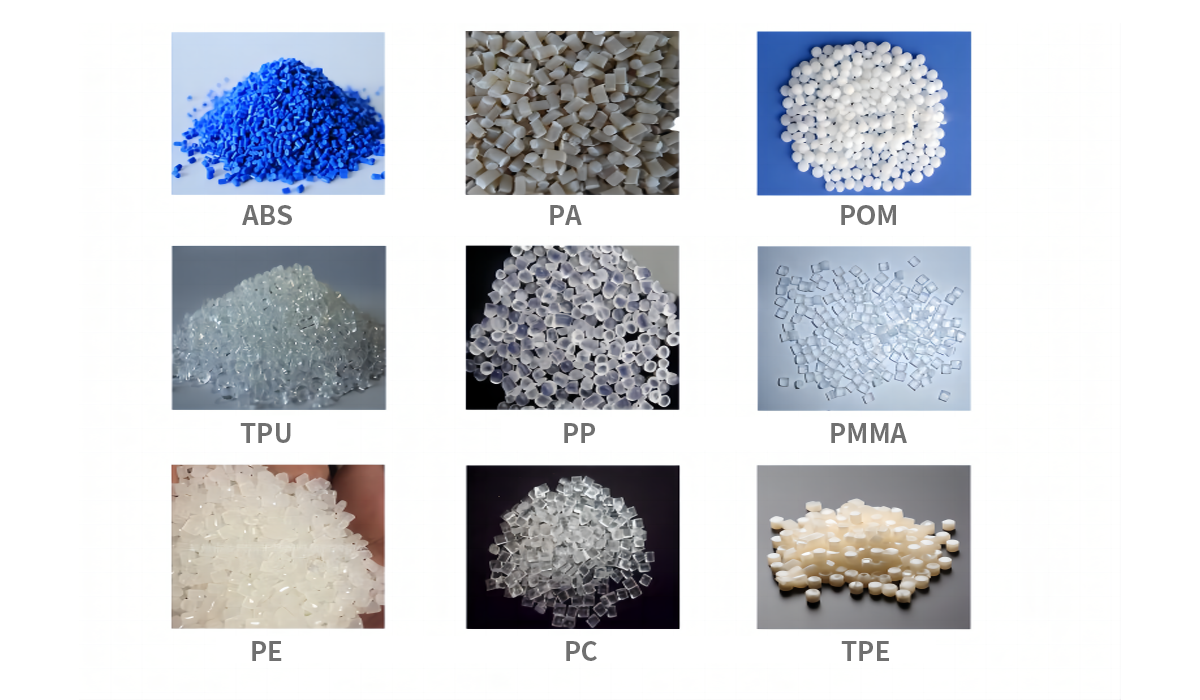
How to Choose the Right Injection Molding Material
Mechanical Strength
Does your part need to withstand heavy loads or repeated impacts?
Heat Resistance
Will your product operate in high-temperature environments?
Chemical Resistance
Will the part contact oil, fuel, acid, or cleaning chemicals?
Flexibility
Does your product require elasticity or a soft-touch surface?
Transparency
Does the product need optical clarity?
Low Cost
Is cost your primary concern?
Injection Molding Material Comparison Table
| Material | Strength | Heat | Flexibility | Cost | Typical Applications |
|---|---|---|---|---|---|
| ABS | ★★★★ | ★★★ | ★★ | Low | Electronics |
| PP | ★★★ | ★★★ | ★★★ | Very Low | Packaging |
| PC | ★★★★★ | ★★★★ | ★★ | Medium | Automotive |
| PA66 | ★★★★★ | ★★★★ | ★★ | Medium | Machinery |
| POM | ★★★★★ | ★★★★ | ★ | Medium | Precision Parts |
| PMMA | ★★★ | ★★★ | ★ | Medium | Optical |
| HDPE | ★★★ | ★★★ | ★★★ | Low | Containers |
| PVC | ★★★ | ★★★ | ★★ | Low | Pipe |
| TPE | ★★ | ★★ | ★★★★★ | Medium | Grips |
| TPU | ★★★★ | ★★★★ | ★★★★★ | Medium | Wheels |
| TPR | ★★★ | ★★ | ★★★★★ | Low | Handles |
| PPS | ★★★★★ | ★★★★★ | ★ | High | Automotive |
| LCP | ★★★★★ | ★★★★★ | ★ | Very High | Electronics |
Common Injection Molding Materials Encyclopedia
1. ABS (Acrylonitrile Butadiene Styrene)
Key Properties
- Excellent impact resistance
- Good dimensional stability
- Easy to machine and paint
- Attractive surface finish
- Cost-effective
Typical Applications
- Consumer electronics housings, Automotive interior parts, Household appliances, Plastic enclosures, Toys.
2. Polypropylene (PP)
Key Properties
- Lightweight
- Excellent chemical resistance
- Good fatigue resistance
- Moisture resistant
- Flexible
Typical Applications
- Food containers, Living hinges, Automotive battery cases, Medical containers, Packaging.
3. Polycarbonate (PC)
Key Properties
- High impact strength
- Transparent
- Excellent heat resistance
- Good dimensional accuracy
Applications
- Safety goggles, Medical devices, Automotive lighting, Electrical components, Optical lenses.
4. Nylon (PA6 / PA66)
Key Properties
- High mechanical strength
- Excellent wear resistance
- Self-lubricating
- Good fatigue resistance
Applications
- Gears, Bearings, Automotive components, Industrial machinery, Cable ties.
5. POM (Acetal / Delrin)
Key Properties
- Excellent dimensional stability
- Low friction
- High stiffness
- Excellent fatigue strength
Applications
- Precision gears, Bearings, Valve components, Mechanical parts, Conveyor components.
6. PMMA (Acrylic)
Key Properties
- Crystal clear transparency
- UV resistant
- Weather resistant
- Excellent surface finish
Applications
- Light covers, Display panels, Automotive lenses, Signage, Optical products.
7. HDPE
Key Properties
- Excellent chemical resistance
- Tough, Moisture resistant
- Lightweight
Applications
- Chemical containers, Storage tanks, Pipes, Industrial products.
8. PVC
Key Properties
- Flame resistant
- Chemical resistant
- Electrical insulation
- Cost-effective
Applications
- Electrical fittings, Pipe fittings, Construction products.
9. PEEK
Key Properties
- Extremely high temperature resistance
- Outstanding mechanical strength
- Excellent chemical resistance
- Medical-grade compatibility
Applications
- Aerospace, Medical implants, Oil & Gas, Semiconductor equipment.
10. TPE (Thermoplastic Elastomer)
Key Properties
- Soft rubber-like feel
- Excellent elasticity
- Weather/UV resistance
- Easy to process and recycle
- Overmoldable
Typical Applications
- Soft-touch grips, Medical devices, Seals, Consumer electronics, Sporting goods, Kitchenware.
11. TPU (Thermoplastic Polyurethane)
Key Properties
- Outstanding abrasion resistance
- High tensile strength
- Oil and grease resistant
- Superior elasticity
Typical Applications
- Phone cases, Industrial rollers, Automotive seals, Wheels, Medical tubing, Wear-resistant parts.
12. TPR (Thermoplastic Rubber)
Key Properties
- Slip resistance
- Good shock absorption
- Easy coloring
- Cost-effective rubber alternative
Typical Applications
- Tool handles, Footwear soles, Household products, Children's toys, Hand grips, Anti-slip pads.
13. PPS (Polyphenylene Sulfide)
Key Properties
- Excellent high-temp resistance
- Outstanding chemical resistance
- Low moisture absorption
- Flame retardant
Typical Applications
- Engine components, Electrical connectors, Pump housings, Industrial valves, Sensors.
14. LCP (Liquid Crystal Polymer)
Key Properties
- Ultra-high dimensional stability
- Extremely low shrinkage
- Flowability for thin-wall
- Excellent electrical insulation
Typical Applications
- Electronic connectors, 5G components, Smartphone connectors, Medical instruments, Precision parts.
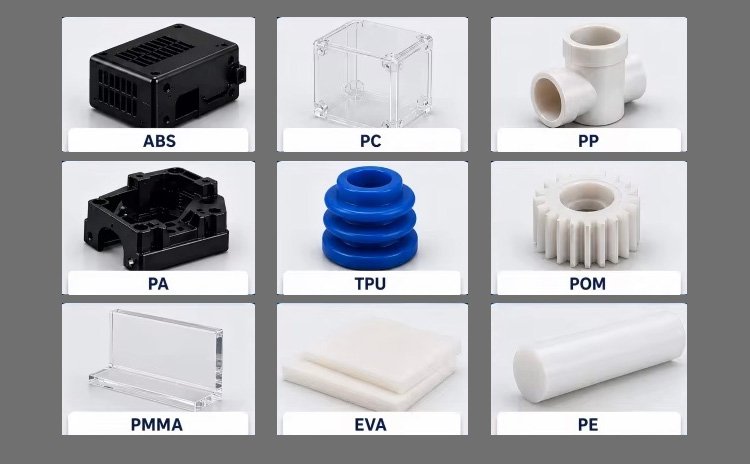
Injection Molding Materials by Industry
| Industry | Recommended Materials |
|---|---|
| Automotive | PA66, POM, PPS, PC, ABS, TPU |
| Consumer Electronics | ABS, PC, LCP, PMMA |
| Medical Devices | PP, PC, TPE, TPU |
| Industrial Equipment | PA66, POM, PPS, HDPE |
| Food & Packaging | PP, HDPE |
| Electrical Components | PC, PPS, LCP |
| Outdoor Products | ASA, PP, HDPE, TPU |
| Precision Engineering | POM, PPS, LCP |
Why Material Selection Matters
Using the correct material can significantly impact the success of your project:
- Extend product lifespan
- Reduce manufacturing costs
- Improve product quality
- Minimize deformation and shrinkage
- Enhance customer satisfaction
Experienced injection molding manufacturers often assist customers in selecting the optimal resin based on product function, production volume, and industry standards.
Need Help Selecting the Right Plastic Material?
At XJH MFG, we provide professional material selection support for custom injection molding projects. Whether you need cost-effective consumer products or high-performance engineering components, our engineers can recommend the most suitable plastic resin based on your application, budget, and production requirements.
Frequently Asked Questions
What is the most commonly used plastic for injection molding?
ABS and polypropylene (PP) are among the most widely used materials due to their balance of performance, cost, and ease of processing.
Which plastic is best for high-strength parts?
Polycarbonate (PC), Nylon (PA66), POM, and PEEK are excellent choices for high-strength engineering applications.
Which plastic has the best chemical resistance?
Polypropylene (PP), HDPE, and PEEK offer outstanding resistance to chemicals and corrosion.
Which material is best for transparent products?
PMMA (Acrylic) provides excellent optical clarity, while Polycarbonate (PC) offers both transparency and superior impact resistance.
Can one mold process different materials?
Yes, but processing parameters such as melt temperature, mold temperature, cooling time, and shrinkage rate must be adjusted for each resin.