
Project Overview
A manufacturer of industrial automation equipment required a series of functional prototype components to verify mechanical assemblies before moving into production.
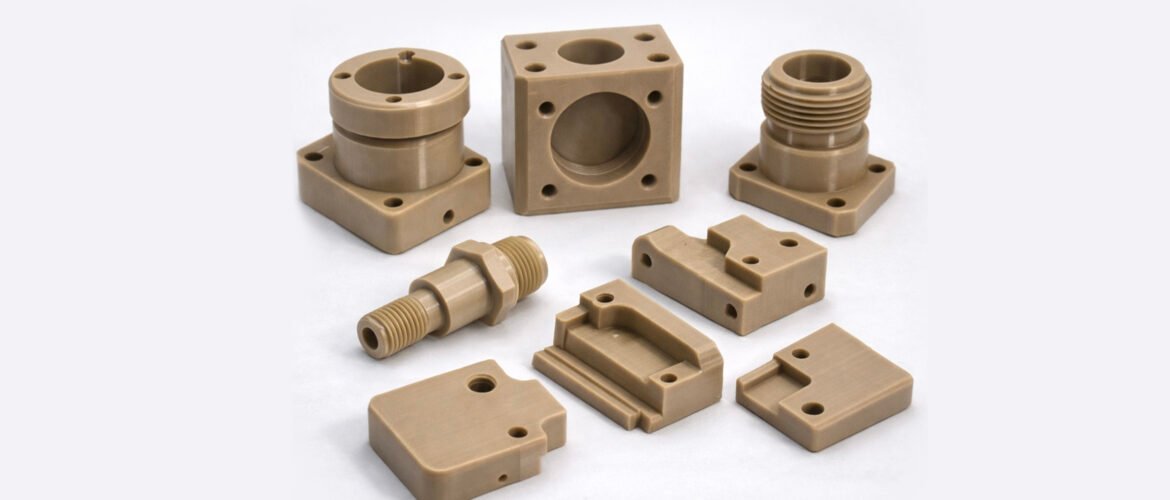
The project involved multiple engineering plastic parts with varying geometries, including threaded connectors, mounting bases, housing components, guide blocks, and structural fixtures.
The customer needed rapid prototyping services capable of delivering high dimensional accuracy, fast turnaround, and reliable assembly performance while avoiding the costs associated with early-stage tooling.
Customer Requirements
The project required the production of several prototype components featuring:
- Internal and external threaded features
- Mounting holes and fastening interfaces
- Structural support components
- Precision alignment features
- Functional mating surfaces
- Mechanical assembly verification
The prototypes would be used for engineering evaluation, assembly testing, and design optimization before mold development.
Challenges
Complex Geometries
Several components included intricate features such as threaded interfaces, recessed cavities, precision holes, and assembly slots.
Multi-Part Assembly Verification
All parts needed to fit together accurately within the customer’s equipment system.
Short Development Schedule
The customer required physical parts within days to maintain project timelines.
Cost Control
The customer wanted to avoid investing in production tooling before design validation.
Our Solution
After reviewing the CAD files, our engineering team recommended rapid prototyping using high-precision additive manufacturing technology.
Manufacturing Process
- Technology: Rapid Prototyping
- Material: Engineering Resin
- Layer Thickness: 0.05 mm
- Surface Treatment: Precision Finishing
- Lead Time: 4 Days
The complete prototype set was manufactured directly from 3D CAD models without tooling investment.
Prototype Components Produced
Threaded Connector Parts
Several components incorporated internal and external threads for fluid and mechanical connection testing.
Mounting Blocks
Structural mounting parts were produced to validate fastening positions and assembly tolerances.
Housing Components
Prototype housings allowed engineers to evaluate internal clearances and installation requirements.
Functional Mechanical Features
Guide slots, support ribs, mounting surfaces, and alignment structures were reproduced with high precision.
Results
Following prototype delivery, the customer completed full assembly testing and identified several design improvements.
Key Outcomes
✓ Successful assembly validation
✓ Verification of threaded connections
✓ Reduced tooling risk
✓ Faster engineering decision-making
✓ Improved design confidence before production
The final optimized design proceeded to tooling and mass production with significantly lower development risk.
Technical Specifications
| Item | Specification |
|---|---|
| Application | Industrial Equipment |
| Process | Rapid Prototyping |
| Material | Engineering Resin |
| Surface Finish | Smooth Matte Finish |
| Lead Time | 4 Days |
| Accuracy | ±0.05–0.15 mm |
| Quantity | Multi-Part Prototype Set |
| Purpose | Functional Testing & Design Validation |
Why Rapid Prototyping Was the Right Choice
For engineering assemblies involving multiple interacting components, rapid prototyping provides a fast and cost-effective way to evaluate designs before committing to production tooling.
Benefits include:
- Faster product development
- Lower prototype costs
- High dimensional accuracy
- Complex geometry capability
- Functional assembly verification
- Reduced mold modification risk
Project Highlights
Multi-Part Functional Assembly
The prototype set included several mating components requiring accurate fit and alignment.
Thread Verification
Internal and external threaded features were successfully tested.
Fast Turnaround
Complete prototype production was completed within four working days.
Production Readiness
The validated design moved confidently into the next manufacturing stage.