
Injection Molding Surface Finishes: A Complete Guide to SPI, VDI, Mold-Tech & Post-Processing
When manufacturing injection molded plastic parts, surface finish is just as important as material selection and dimensional accuracy. The right surface finish not only improves appearance but also enhances functionality, durability, and user experience.
From high-gloss transparent lenses to textured industrial enclosures, different finishing methods are selected based on product requirements.
In this guide, we’ll explain the most common injection molding surface finishes, international standards, and post-processing options to help you choose the best finish for your next project.
Why Surface Finish Matters
Surface finish affects far more than aesthetics.
A properly selected finish can:
- Improve product appearance
- Hide weld lines and sink marks
- Reduce fingerprints
- Increase scratch resistance
- Enhance grip
- Improve paint adhesion
- Create premium product aesthetics
- Meet customer brand requirements
For many consumer and industrial products, surface finish is one of the first things customers notice.
1. SPI Surface Finish Standard
The Society of the Plastics Industry (SPI) standard is the most widely recognized mold polishing standard worldwide.
It classifies mold finishes into four categories.
| Grade | Finish | Method | Typical Applications |
|---|---|---|---|
| SPI A | Mirror Polish | Diamond Buffing | Optical lenses, transparent PC, medical devices |
| SPI B | Semi-Gloss | Fine Sandpaper | Consumer electronics |
| SPI C | Matte Finish | Stone Polishing | Plastic housings, industrial parts |
| SPI D | Rough Finish | Dry Blasting | Functional parts, hidden surfaces |
SPI A – Mirror Finish
Mirror polishing creates an extremely smooth, reflective surface.
Typical applications include:
- PMMA lenses
- PC transparent covers
- Light guides
- Medical components
Advantages:
- Highest gloss
- Excellent transparency
- Easy to clean
SPI B – Semi-Gloss Finish
This finish provides a smooth appearance without the high cost of mirror polishing.
Common applications:
- Home appliances
- Consumer products
- Plastic enclosures
SPI C – Matte Finish
Stone polishing creates a low-gloss, non-reflective surface.
Benefits:
- Reduces fingerprints
- Hides molding defects
- Professional appearance
SPI D – Rough Finish
Produced by dry blasting.
Commonly used for:
- Internal components
- Industrial products
- Non-visible surfaces
2. VDI 3400 Texture
VDI 3400 is the most popular texture standard used in Europe, especially in the automotive industry.
Unlike polished surfaces, VDI textures are produced by electrical discharge machining (EDM), creating a controlled textured appearance.
Common texture grades include:
- VDI 12
- VDI 18
- VDI 24
- VDI 27
- VDI 30
- VDI 33
- VDI 36
- VDI 45
Higher VDI numbers produce rougher textures.
Typical applications include:
- Automotive interior components
- Electronic housings
- Power tool casings
- Industrial equipment
Advantages:
- Excellent scratch resistance
- Anti-slip surface
- Reduced fingerprints
- Premium appearance
3. Mold-Tech Texture
Mold-Tech (MT) textures are widely used in North America.
These textures simulate natural materials such as:
- Leather
- Wood grain
- Fine matte
- Sand texture
- Stone texture
They are commonly specified for automotive interiors, consumer products, and premium appliance housings.
Compared with SPI polishing, Mold-Tech textures offer greater design flexibility and improved visual appeal.
4. EDM Surface Finish
EDM (Electrical Discharge Machining) naturally leaves a textured surface on the mold.
Rather than polishing it away, manufacturers sometimes retain the EDM texture for functional parts.
Advantages include:
- Lower mold manufacturing cost
- Improved mold venting
- Faster tooling production
Typical applications:
- Internal components
- Structural parts
- Engineering prototypes
5. Sandblasted Finish
Sandblasting uses fine glass beads or aluminum oxide to create a uniform matte appearance.
Features:
- Soft visual effect
- Uniform texture
- Reduced glare
It is commonly used for industrial equipment and consumer electronics.
Plastic Part Post-Processing
Not every surface finish is created directly in the mold.
Many products require additional finishing after molding.
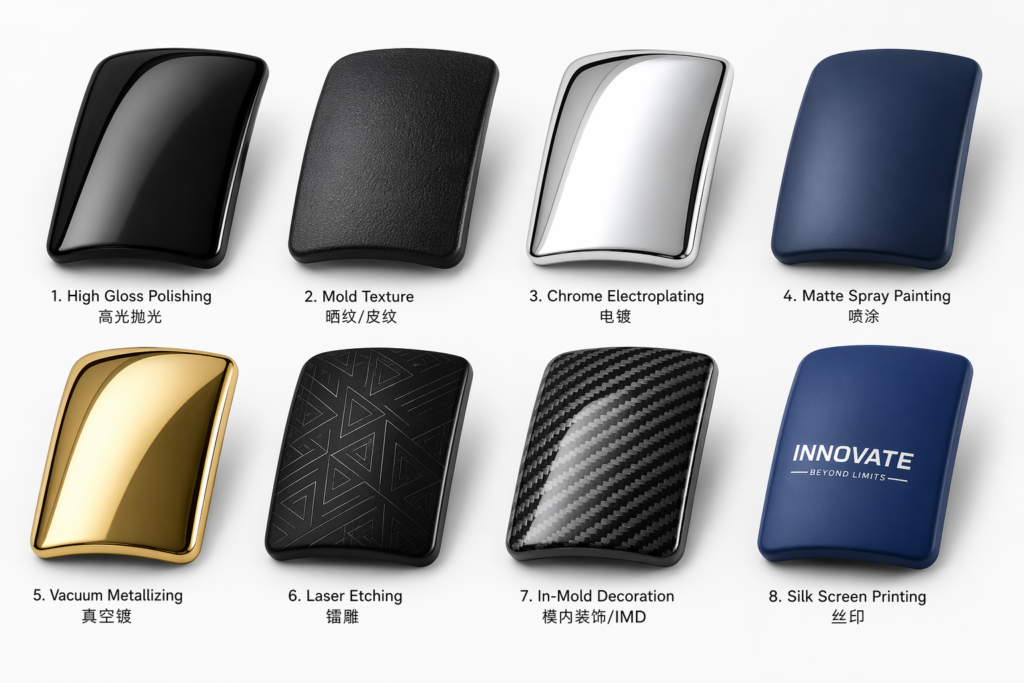
Spray Painting
Spray painting adds color, UV resistance, and premium aesthetics.
Common finishes include:
- Gloss
- Matte
- Metallic
- Soft-touch coating
Silk Screen Printing
Ideal for:
- Company logos
- Icons
- Product labels
- Control panels
Pad Printing
Suitable for curved or irregular surfaces where screen printing is not practical.
Laser Engraving
Laser engraving provides permanent markings such as:
- Logos
- Serial numbers
- QR codes
- Traceability information
Vacuum Metallization & Chrome Plating
These processes create a metallic appearance without increasing product weight.
Common colors include:
- Chrome
- Black chrome
- Gold
- Silver
Applications:
- Automotive trim
- Consumer electronics
- Decorative products
IMD / IML (In-Mold Decoration)
IMD and IML integrate decorative films directly into the molding process.
Benefits include:
- Outstanding wear resistance
- Permanent graphics
- Premium appearance
- No peeling or fading
Widely used in:
- Automotive interiors
- Home appliances
- Medical equipment
- Consumer electronics
How to Choose the Right Surface Finish
Selecting the appropriate finish depends on several factors:
- Product appearance requirements
- Functional performance
- Material type
- Production volume
- Budget
- Industry standards
- End-user environment
For example:
- Transparent PC lenses typically require SPI A1 mirror polishing.
- Industrial enclosures often use VDI 24 or VDI 27 textures for improved grip and reduced fingerprints.
- Consumer electronics frequently combine fine matte molding with spray painting or laser engraving for a premium look.
Discussing these requirements during the design phase can help optimize tooling, reduce costs, and achieve the desired appearance from the first production run.
Conclusion
Surface finish is a critical aspect of injection molding that influences both product quality and customer perception. Whether you need a mirror-polished optical component, a textured industrial housing, or a decorative consumer product, selecting the right finishing method is essential.
At XJH Manufacturing, we provide comprehensive injection molding solutions with a wide range of mold surface finishes and post-processing services. Our capabilities include SPI polishing, VDI 3400 textures, Mold-Tech patterns, painting, printing, laser marking, and decorative coatings—helping customers achieve both functional performance and premium aesthetics.